
Rédigé par le Comité de rédaction de l’antenne à Menton de SPDS.
Over the past twenty five years, Estonia – a north-eastern European state – has developed into becoming a global leader in technology and innovation. These years of major transformations have positioned this nation as a significant actor in cybersecurity and digital defense. This shift towards digitalization began in the early 2000s, in particular upon the series of foreign cyber attacks on the websites of Estonian organizations including the Parliament (Riigikogu), banks, ministries, newspapers and broadcasters. In order to respond to such challenges several cyber experts were brought together1Maclellan, S., & O’Leary, N. (2017, October 26). Doing battle in cyberspace: How an attack on Estonia changed the rules of the game. Centre for International Governance Innovation. https://www.cigionline.org/articles/doing-battle-cyberspace-how-attack-estonia-changed-rules-game/ in the interests of national security. Although the outcome was in favor of the Estonians, it underscored the necessity of more robust defense systems to address any other potential future attacks. Since then, Estonia has continuously advanced its digital approaches and strategies both nationally and across Europe, making it third globally2NCSI Development. NCSI :: Ranking – National Cyber Security Index. https://ncsi.ega.ee/ncsi-index/. This article aims to examine Estonia’s role in influencing and shaping Europe – European Union (EU), NATO and Ukraine – when it comes to defense.
I. The European Union
As part of the European Union, Estonia has developed an approach which has put its security interests as an emphasized focus, to the extent that this expertise has been able to be applied within the Union. Following the publication of the first cybersecurity strategy in 2013, the policy was further developed into a diplomatic framework in 2017, initiated by the Estonian presidency of the European Council. The later created the Cyber Diplomacy Toolbox (CDT), which aims to respond to malicious cyber activities in order to limit their effects and reduce the risk of harm to the Union’s values and interests. The urgency of such a measure was underscored by major cyber incidents such as the 2017 NotPetya attack in 2017, a wiper malware operation that caused 10 billion USD in losses globally. It would permanently destroy data on Windows systems by encrypting the Master File Table, making it impossible to access any files on the hard disk. It served as a suitable framework as later they would be put in place. On 30 July 2020, the Council of the European Union unanimously imposed restrictive measures against six individuals and three entities that had been found to be responsible or in any way involved in different cyberattacks by the concerned members. Therefore strengthening its credibility as a cyber actor3De Tomas Colatin, S. Si vis cyber pacem, para sanctiones: The EU cyber diplomacy toolbox in action. NATO Cooperative Cyber Defence Centre of Excellence. https://ccdcoe.org/library/publications/si-vis-cyber-pacem-para-sanctiones-the-eu-cyber-diplomacy-toolbox-in-action/.
This joint approach among member states overall include4General Secretariat of the Council. (2023, June 8). Revised implementing guidelines of the Cyber Diplomacy Toolbox (Document No. ST‑10289‑2023‑INIT). Council of the European Union. https://data.consilium.europa.eu/doc/document/ST-10289-2023-INIT/en/pdf:
- Asset freezes, in order to prevent access to financial assets within the EU.
- Travel ban, including entering or transiting through the EU.
- EU persons and entities are prohibited from doing business with listed individuals and entities (providing funds, financial assets, or economic resources)
II. NATO
Apart from its influence in regards to an initiation of the principles framework5Council of the European Union. (2017, June 19). ST‑10424‑2017‑VF. https://www.consilium.europa.eu/media/22366/st10424en17-vf.pdf Estonia has been influenced via hosting the Locked Shields annually in its capital, Tallinn, since 2010. It is organized by the North Atlantic Treaty Organization (NATO) Cooperative Cyber Defense of Excellence which holds the purpose of enabling cyber security experts to enhance skills in defending national IT systems through realistic scenarios which simulates in making strategic decision-making legal, and communication aspects. In 2025, Tallinn hosted about 4 000 cyberexperts from 41 nations, both from NATO Allies and Partners6NATO Cooperative Cyber Defence Centre of Excellence. (2025). Locked Shields. https://ccdcoe.org/news/2025/nations-unite-under-pressure-as-locked-shields-2025-kicks-off-in-tallinn/. Despite NATO having several non-EU members, it is important to note that there is great influence on European territory and every state’s participation is seen as a value as it evolves strategy.
III. Ukraine
Since 2014, Estonia has played an active role in supporting Ukraine’s defense and increasing its assistance following the full scale invasion. Between 2022 and early 2026, Estonia has spent 2.8 percent of its GDP in total on bilateral aid7Kiel Institut für Weltwirtschaft. (2025, August 1). Bilateral aid allocations to Ukraine as a share of 2021 donor country gross domestic product (GDP) between January 24, 2022 and June 30, 2025, by country. Statista. https://www.statista.com/statistics/1303450/bilateral-aid-to-ukraine-in-a-percent-of-donor-gdp/. Its involvement has allowed for the testing of different technologies, promoting advancement in the field for Europe. This effort of collaboration with the allies has allowed Estonia to evaluate new systems in real world conditions which has provided development in European defense capabilities8Slusher, M. (2025, May 2). Lessons from the Ukraine conflict: Modern warfare in the age of autonomy, information, and resilience. Center for Strategic and International Studies. https://www.csis.org/analysis/lessons-ukraine-conflict-modern-warfare-age-autonomy-information-and-resilience. There are around three types of warfare that have been considered to be the most visible and widely reported according to several public reports which have been received through donation funds or from allies. In this article, the focus will be on the Ghost Dragon ISR, Eos C VTOL and THeMIS which have been developed by Estonian tech companies.
The Ghost Dragon ISR, a quadcopter drone with main features such as thermal and visual‑light cameras, as well as jamming‑resistant audio systems and anti‑spoofing capabilities. In addition its efficient temperature resistance from -20 to +45 degrees Celsius, the Global Navigation Satellite System (GNSS) included, store reconnaissance data on an SD card and many other of its functions have been found in the front lines in Zaporizhzhia, Ukraine since mid 20229The Ghost Dragon SR. KrattWorks | Ghost Dragon tactical ISR UAV. KrattWorks. https://www.krattworks.com/isr-ghostdragon.
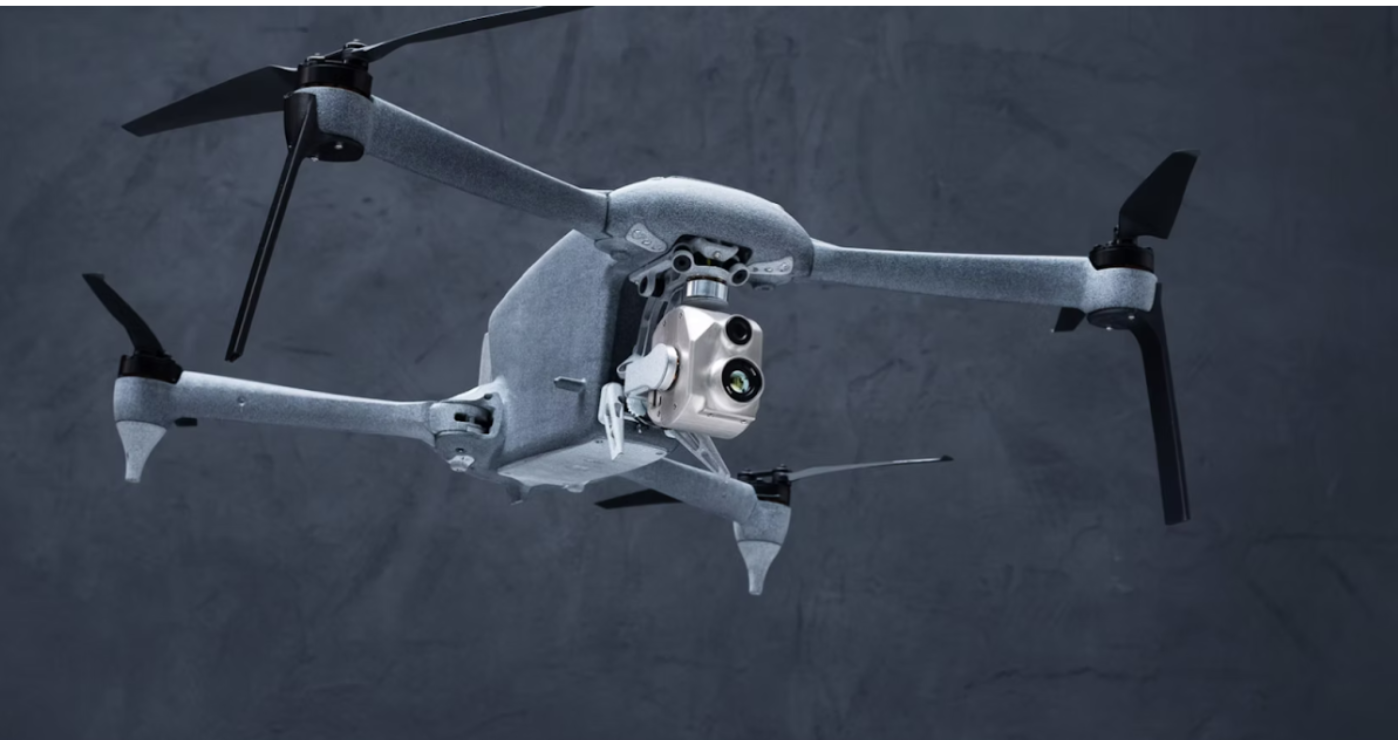
Figure 1- Ghost Dragon ISR by KrattWorks, designed for operations in radio-interference environments.
The Eos C VTOL, a mini unmanned aerial vehicle with low noise and visual footprint due to its distinctively light color. It serves as a long-range surveillance with target acquisition and is fully electric. Its temperature resistance ranges from -20 to +50 degrees Celsius, the ability to take off and land vertically is what makes it distinguishable and esteemed as it allows for movement in urban, forested, or mountainous territory10Threod Systems. Eos C VTOL. https://www.threod.com/eos-c-vtol/. Ukraine has used them to gather battlefield information, monitor force movements, planning, and receive observational data. The capacity of the system allows it to operate from small or improvised locations11Kushnikov, V. (2024, April 24). The Serhiy Prytula Charity Foundation transferred EOS VTOL drones to the Defence Intelligence of Ukraine. Militarnyi.com. https://militarnyi.com/en/news/the-serhiy-prytula-charity-foundation-transferred-eos-vtol-drones-to-the-defence-intelligence-of-ukraine/.
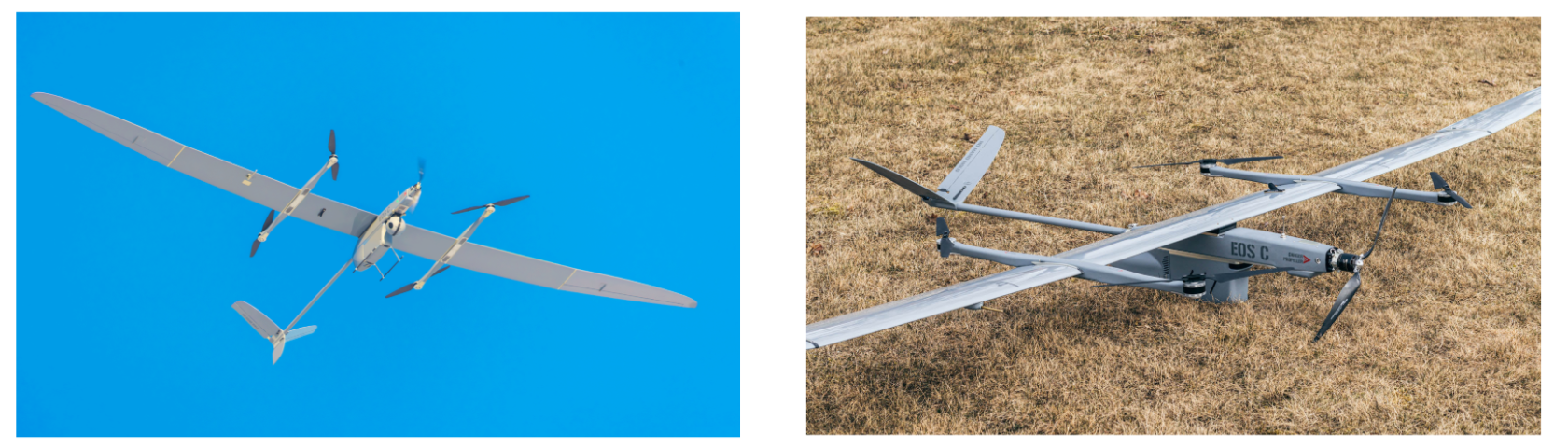
Figure 2, 3- Eos C VTOL by Threod Systems, an unmanned aircraft, designed for rapid deployment and persistent aerial surveillance12 Eos C VTOL – Threod. (2026). Threod.com. https://www.threod.com/eos-c-vtol/
The THeMIS, unmanned ground vehicles (UGV) known for its cost-effectiveness and functionality. Its long operational time from 8 to 15 hours, is equipped with a 1080p camera and multiple power options and assisted with Artificial Intelligence for high performance13Milrem Robotics. (2025, February 13). THeMIS – Milrem. https://milremrobotics.com/themis-family/. Its usage is prominent in 19 countries, notably in Ukraine. One of its aims is to act as a re-supply vehicle instead of heavy trucks that tend to have difficulty circulating with conditions such as muddy season and used by engineers to carry anti-tank mines to accelerate mining operations14Milrem Robotics. (2024, January 11). Ukrainian forces are taking full advantage of their THeMIS UGVs. Milrem Robotics. https://milremrobotics.com/ukrainian-forces-are-taking-full-advantage-of-their-themis-ugvs/.
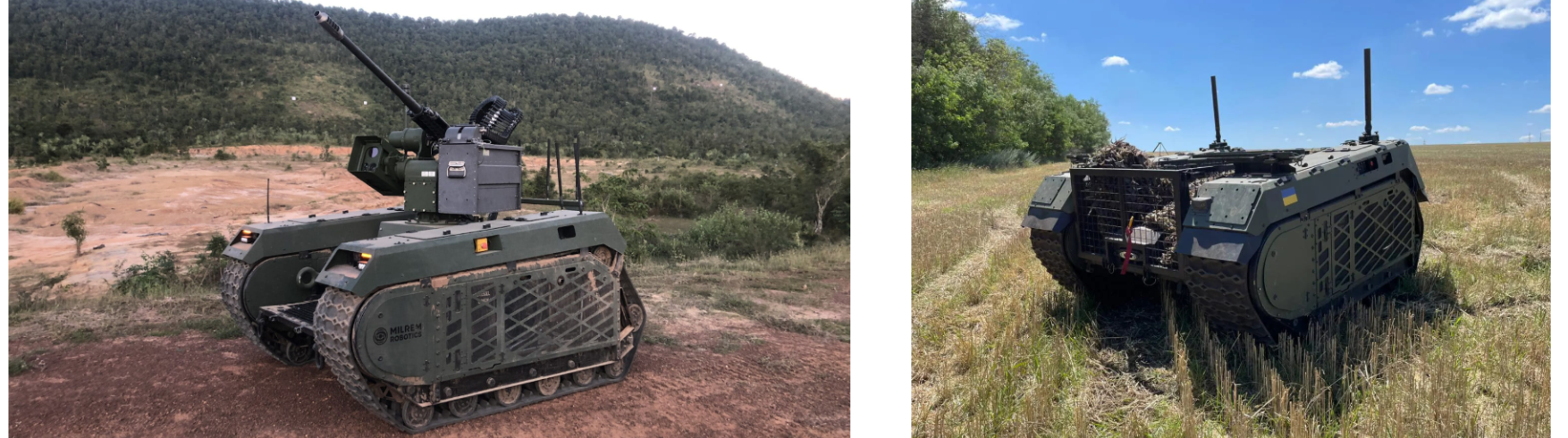
Figure 3,4- THeMIS by Milrem Robotics, a multi role UGV intended to reduce the number of troops on the battlefield15Milrem Robotics. (2022, February 8). Milrem Robotics delivered the THeMIS Combat UGV to Thailand.Milrem Robotics. https://milremrobotics.com/milrem-robotics-delivered-the-themis-combat-ugv-to-thailand/16 Milrem Robotics. (2025, September 3). Milrem Robotics to deliver a record number of THeMIS UGVs to Ukraine in collaboration with an EU member country – Milrem. Milrem Robotics. https://milremrobotics.com/milrem-robotics-to-deliver-a-record-number-of-themis-ugvs-to-ukraine-in-collaboration-with-an-eu-member-country/
Despite its strong presence in Ukraine all of the above has been exported to several European NATO members such as Lithuania, France, Germany, the Netherlands, Norway, the UK.
The provision of these different innovative technologies to Ukraine reflects the confidence European states have in their use, as many are also employed within the national defense structures of the donor states.
Conclusion
One can ask: How can a small nation’s digital innovation contribute to a stronger, more resilient Europe? Estonia’s involvement in cybersecurity policy within the European Union, its participation in NATO, and its role in supplying and supporting certain technological systems in relation to Ukraine has shown its ability to apply expertise to support regional security, to the extent of being impactful.
Written by Mirel Luts, First-Year Undergraduate Student at Sciences Po, Menton Campus.
Bibliography (American Psychological Association)
De Tomas Colatin, S. Si vis cyber pacem, para sanctiones: The EU cyber diplomacy toolbox in action. NATO Cooperative Cyber Defence Centre of Excellence. https://ccdcoe.org/library/publications/si-vis-cyber-pacem-para-sanctiones-the-eu-cyber-diplomacy-toolbox-in-action/
General Secretariat of the Council. (2023, June 8). Revised implementing guidelines of the Cyber Diplomacy Toolbox (Document No. ST‑10289‑2023‑INIT). Council of the European Union. https://data.consilium.europa.eu/doc/document/ST-10289-2023-INIT/en/pdf
Kiel Institut für Weltwirtschaft. (2025, August 1). Bilateral aid allocations to Ukraine as a share of 2021 donor country gross domestic product (GDP) between January 24, 2022 and June 30, 2025, by country. Statista. https://www.statista.com/statistics/1303450/bilateral-aid-to-ukraine-in-a-percent-of-donor-gdp/
Maclellan, S., & O’Leary, N. (2017, October 26). Doing battle in cyberspace: How an attack on Estonia changed the rules of the game. Centre for International Governance Innovation. https://www.cigionline.org/articles/doing-battle-cyberspace-how-attack-estonia-changed-rules-game/
Milrem Robotics. (2022, February 8). Milrem Robotics delivered the THeMIS Combat UGV to Thailand. Milrem Robotics. https://milremrobotics.com/milrem-robotics-delivered-the-themis-combat-ugv-to-thailand/
Milrem Robotics. (2024, January 11). Ukrainian forces are taking full advantage of their THeMIS UGVs. Milrem Robotics. https://milremrobotics.com/ukrainian-forces-are-taking-full-advantage-of-their-themis-ugvs/
Milrem Robotics. (2025, February 13). THeMIS – Milrem. https://milremrobotics.com/themis-family/
NCSI Development. NCSI :: Ranking – National Cyber Security Index. https://ncsi.ega.ee/ncsi-index/
Slusher, M. (2025, May 2). Lessons from the Ukraine conflict: Modern warfare in the age of autonomy, information, and resilience. Center for Strategic and International Studies. https://www.csis.org/analysis/lessons-ukraine-conflict-modern-warfare-age-autonomy-information-and-resilience
The Ghost Dragon SR. KrattWorks | Ghost Dragon tactical ISR UAV. KrattWorks. https://www.krattworks.com/isr-ghostdragon
Threod Systems. Eos C VTOL. https://www.threod.com/eos-c-vtol/
Council of the European Union. (2017, June 19). ST‑10424‑2017‑VF. https://www.consilium.europa.eu/media/22366/st10424en17-vf.pdf
Kushnikov, V. (2024, April 24). The Serhiy Prytula Charity Foundation transferred EOS VTOL drones to the Defence Intelligence of Ukraine. Militarnyi.com. https://militarnyi.com/en/news/the-serhiy-prytula-charity-foundation-transferred-eos-vtol-drones-to-the-defence-intelligence-of-ukraine/
Locked Shields. (2025). Locked Shields. NATO Cooperative Cyber Defence Centre of Excellence. https://ccdcoe.org/news/2025/nations-unite-under-pressure-as-locked-shields-2025-kicks-off-in-tallinn
